Monday, May 23, 2011
Virtual Art Presentation
Hope your summer is going well so far, despite the rain. And cold. It will be summer weather soon! Last weekend was the 7th Media in Transition conference at MIT, a biannual event that I look forward to every time. It's always interesting to see how people are defining and redefining the field of "media." The topic was "Unstable Platforms: The Promise and Peril of Transition," an intriguing concept to think about in all kinds of ways. My abstract grew into a huge paper (some links don't seem to work on every computer). I'll put the slides for the presentation I gave on virtual art in this post. And the part of the paper on virtual art is here.

Thursday, May 5, 2011
Technology of the Future Chart
Hi everyone!
I just found this and thought it was extremely relevant to topics we discussed in class.
Take a look!
Here's the link too: http://michellzappa.com/map/envisioning-technology-2011-03-07.png

I just found this and thought it was extremely relevant to topics we discussed in class.
Take a look!
Here's the link too: http://michellzappa.com/map/envisioning-technology-2011-03-07.png

Saturday, April 30, 2011
Thursday, April 28, 2011
The Queen of Tarts Game
Hi! Here is my Final Project for the class if anyone would like to try playing it! Just click to begin your Wonderland Adventure :)
Have fun and good luck!
-Kristin
Have fun and good luck!
-Kristin
Tuesday, April 26, 2011
Paidia and Ludus Revisited
Let's think about paidia and ludus again, and how they might relate to narrative, in games and in digital media broadly. When we consider "narrative" as telling, not necessarily as plot, what does that reveal? Is telling always antithetical to doing? Do we not tell as we do? The answer may be in the difference between Red vs. Blue and Halo gameplay.
Thursday, April 7, 2011
PROJECT PLANNING WORKSHEET (“It furthers to have somewhere to go.”)
The projects you've done so far have been terrific--the digital retellings of fairy tales, and the blue sky projects. Now we move towards the final project. Here is the worksheet we'll use as the basis for some of today's class. You have storyboard templates and game design tools for more specific preproduction planning.
PROJECT PLANNING WORKSHEET (“It furthers to have somewhere to go.”)
With a partner, work through the steps on this sheet. You can interview or guide your partner through the parts, then switch.
1) Project idea:
2) Title:
3) Break it down into pieces.
COMPONENTS TOOLS
4) What new skills do you need to learn? How will you learn them?
Sunday, April 3, 2011


Tuesday, March 29, 2011
Cinematography and Machinima
We've spent some time thinking about game aesthetics and structure, and let's now turn to the moving image outside its interactive role, whether it be in cut scenes in a game, or a film/movie/animation. We'll use the example of machinima as one form of moving image creation and capture. After we get past the setup, many of the principles of cinematography and editing are the same as for any moving image, and you can follow or break the rules as you wish. Here are the notes for today's class, so you can concentrate on the ideas and the activities.
MISE-EN-SCENE: What's in the shot
Setting
Costume
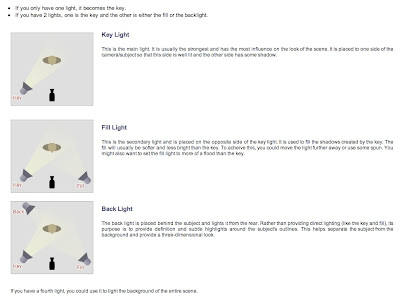
Lighting
Figure Expression and Movement
LIGHTING: 3 POINT LIGHTING: key, fill, back

MACHINIMA: Environment lighting, and also lighting kits, or lights you make

PHOTOGRAPHIC QUALITIES OF THE SHOT
Look of an image
balance of dark and light
depth of space in focus
relation of background and foreground
use of color, saturation, tone
focus
lenses to change depth in a shot (either fixed with a telephoto or fish eye, or rack or zoom shots)
FRAMING
Angle
Height of the camera
Canted angles
Following shot (moving camera):PANNING, TRACKING, TILTING, CRANING
Point of view shot
SCALE/PROXIMITY
ELS: landscape, crowd, building--establishing shot
LS: Standing human figure is height of screen (roughly)--character and surroundings
MLS: knees/mid-thigh up (shot Americain bc of its use in cowboy pictures)
MCU: chest up--get to see the face, gestures
CU: head
ECU: small object, part of the body

CAMERA MOVEMENT
crane
handheld, steadycam
pan
tilt
tracking shot
whip pan
For Machinima: Space Navigator 3-d mouse

What to do with those shots!
EDITING AND MONTAGE
Editing can be based on rhythm, time, space, tone, theme
"The Kuleshov Effect" With his experiment, Kuleshov learned 3 things:
1) a cut could serve a narrative function (eyeline match, flashback, what a character is thinking)
2) also it could generate an intellectual response—(metaphor, contrast, parallel)
3) emotional cut: rhythmic, tonal (increasingly dark or light0, form cut (match cut), directional cut
a single cut can function on all three levels: narrative, intellectual, emotional
Straight cut
Jump cut
Cross cut (or parallel cut)
Contrast cut
Form cut (match cut)
TRANSITIONS:
Fade-out
Fade-in
Dissolve
Synecdoche (part for a whole)
Form dissolve
Wipe
Iris
Monday, March 21, 2011
Ambiguity! (Is that clear?)
Brian Sutton-Smith's chapter "Play and Ambiguity" brings a lot of things together, and raises even more questions for our exploration of play and games. As we move towards the proposal for your project, and the class bifurcates (I just love working that word in whenever I can) into clusters around games or films, we will have different interests in play and ambiguity. But before that, we'll create some of our own games together as a group in the next couple of weeks.
So, back to some key concepts. Here are William Empson's seven kinds of ambiguity, ripped from p. 298 of Sutton-Smith's chapter.

Sutton-Smith outlines seven rhetorics, seeming to want to contribute seven of something of his own (and making me anxious that my virtual subjectivity definition only has five aspects, clearly lacking a couple):
The Rhetoric of play as . . .
1. progress
2. fate
3. power
4. identity
5. imaginary
6. self
7. frivolous
We shall discuss.
And to test our ambiguity levels, here are the instructions for the surrealist game Exquisite Corpse:
Write an article and an adjective on a piece of paper, then fold it over before passing it to your neighbor. Next, write a noun, then fold and pass. Now a verb, then fold and pass. Back to the article and adjective, then do the hokey pokey. No, really fold and pass, just checking to see if you are paying attention. Finish up with a noun. Unfold the papers and read aloud.
Thursday, March 10, 2011
This is really cool
http://www.wimp.com/reinventeducation/
Awesome TED talk on educational systems using digital media.
Awesome TED talk on educational systems using digital media.
Caillois

Of course there is much more to the two chapters "The Definition of Play" and "The Classification of Games" from Roger Caillois's Man, Play, and Games than only what is represented by the chart (with or without banjo music!)
Paidia: "uncontrolled fantasy," "frolicsome and impulsive exuberance," "anarchic and capricious"
Ludus: "arbitrary, imperative, and purposely tedious conentions," "completely impractical," "requires an ever greater amount of effort, patience, skill, or ingenuity."
Agôn
Alea
Mimicry
Ilinx
Recall our Play! workshop (see cut scenes again here)
Paidia: "uncontrolled fantasy," "frolicsome and impulsive exuberance," "anarchic and capricious"
Ludus: "arbitrary, imperative, and purposely tedious conentions," "completely impractical," "requires an ever greater amount of effort, patience, skill, or ingenuity."
Agôn
Alea
Mimicry
Ilinx
Recall our Play! workshop (see cut scenes again here)
Monday, March 7, 2011
Games and Film: Where Aesthetics Meet and Diverge
Games and Film: Where Aesthetics Meet and Diverge
Opening shot of Welles's Touch of Evil that Solis discusses in his blog post:
Solis writes, "So why do we introduce the camera before we introduce the main character? Simply the camera is more important then Mario in this title." Does Welles's film also introduce the camera before the character?
How has this evolved in games? In film? Why?
From film techniques in games, as so eloquently illustrated by Chris Solis in his analysis of Super Mario 64 to the very different kinds of camera angles and spectatorship that can occur in games, it is instructive to explore these two cultural forms in relationship to each other, and to consider how they have been mutually informing, first with film's influence on games, and now with games' influence on film. We also can include the human-computer interface.
Opening shot of Welles's Touch of Evil that Solis discusses in his blog post:
Solis writes, "So why do we introduce the camera before we introduce the main character? Simply the camera is more important then Mario in this title." Does Welles's film also introduce the camera before the character?
How has this evolved in games? In film? Why?
Sunday, March 6, 2011
Jessica Huber's Fairy Tale Assignment
Here is my completed Fairy Tale assignment. I explored the story of Cinderella as if the characters had Facebook pages. I found this to be quite enjoyable to put together.
Wednesday, March 2, 2011
Building & Machinima Workshop
There is an essential skill that is key for both building and machinima--moving the "camera" in the virtual world. We'll experiment with that, and I'll also show you some tools people have made to help streamline camera positioning. Then you'll try out your cam skills as you create a virtual sculpture and then pop some scripts into it, because that is how the real magic happens. Then we'll break into teams and shoot a little footage.
First, as an example of engaging use of machinima and also an edifiying and entertaining tutorial on the camera:
First, as an example of engaging use of machinima and also an edifiying and entertaining tutorial on the camera:
Slurl to AngryBeth's machinima tv studio with camera switcher (25 L$). You'll need basic prim movement and cam skills to use this.
Building tools on the SL wiki
Script Me, please! 3greenseggs.com autoscript generator. But if you plan on doing any real building or using scripts, you are going to have to learn the basics of lsl, Linden Scripting Language, and how scripts work, so you can figure out what is going wrong when it does, or how to tweak a script you get from a generator, from the wiki, or another source. Simon Kline runs terrific classes in Second Life (see: Kline Labs), and there are other ways to learn as well.
Friday, February 25, 2011
Reactive Music, and Some Questions
I've been experimenting with rjdj's Reactive Music app for iPhone. I used it for the sound for the machinima I made to document a virtual art installation, "IceOpal" and also to augment the thrilling experience of waiting for the T in the subway station. I particularly like how you can hear the bell of the train at the end of that recording/piece. That bell is on the old trains, and I don't think it's changed since I was a kid growing up in Boston.
So here are my questions: What is the visual equivalent of reactive music/sound? The Ascend scene I used for both pieces here doesn't only overlay your recorded sound, but uses it to generate music based on a composition by composer Dizzy Banjo.
And what is the narrative, or storytelling, equivalent????? Can we think about augmented storytelling? What would that be?
So here are my questions: What is the visual equivalent of reactive music/sound? The Ascend scene I used for both pieces here doesn't only overlay your recorded sound, but uses it to generate music based on a composition by composer Dizzy Banjo.
And what is the narrative, or storytelling, equivalent????? Can we think about augmented storytelling? What would that be?
You need to have Flash installed to listen directly on the site. Install Flash or you can download the recording instead
"Waiting Feb 24, 2011 5:00 PM in Hynes T station" by L1

Thursday, February 24, 2011
Kino Eye, Cultural Interfaces,Agency, Storytelling: Synthesis
Today we review Manovich's most pertinent concepts, discuss game design & digital filmmaking/ macinima-making, and think about how it all applies to storytelling.
Monday, February 14, 2011
Cultural Interfaces & Machinima

Today we'll connect the reading you've been doing in Manovich's book with the Unity 3D workshop we did last week and the machinima workshop we'll do this week. As we learn new software programs and become more aware of how cultural forms like games or movies are constructed, we learn new aspects of their interfaces, and I'll keep drawing your attention to that, asking you to reflect upon your experiences as both a maker and a player/spectator/reader of digital narrative. So we need to think a little about subjectivity, and how narrative, and particularly digital narrative can construct it.
Subscribe to:
Posts (Atom)